Key Points:
- BCBA vs RBT refers to two distinct ABA therapy roles.
- The BCBA assesses needs, designs treatment, reviews data, and supervises care, while the RBT delivers direct sessions.
- RBTs follow the approved plan and report observations.
- Parents should bring goals, progress, safety, and treatment changes to the BCBA.
The main BCBA vs RBT difference is responsibility. The Board Certified Behavior Analyst, or BCBA, assesses your child, develops and updates the treatment plan, reviews data, and supervises care. The Registered Behavior Technician, or RBT, usually spends more time providing direct sessions and following that plan.
Parents often know the RBT better because they meet more often. Still, the BCBA remains responsible for clinical decisions. Shared notes, family input, and regular communication connect both roles. Here’s who does what and who should receive your concerns.
BCBA vs RBT: The Parent-Friendly Difference
An RBT may visit several times each week, while the BCBA handles selected observations, planning, and data review as part of the personalized ABA treatment process. More frequent contact does not transfer clinical responsibility to the RBT.
The Behavior Analyst Certification Board defines a BCBA as a graduate-level professional who can practice independently and supervise RBTs. An RBT is a paraprofessional who works under close, ongoing supervision.
These ABA therapy team roles connect. The RBT reports session details. The BCBA combines them with data, observation, and family reports when making decisions.
What Does a BCBA Do for Your Child?
Parents often ask, "What does a BCBA do when I don't see them at every session?" Much of the BCBA's work, part of our individualized ABA therapy services, happens before visits and between direct sessions.
A BCBA may:
- Observe your child and speak with caregivers during the assessment
- Identify strengths, daily needs, and behaviors that need support
- Choose measurable goals with family input
- Write the treatment plan and explain each teaching procedure
- Review session data instead of relying on general impressions
- Observe the RBT and provide feedback, modeling, or added training
- Update goals when data and family reports show a change is needed
- Teach caregivers how to practice approved skills during daily routines
The BCBA should know your child’s goals, progress, and new concerns even when the RBT attends more sessions. Parents can ask why a goal was chosen and when the plan will be reviewed.
What Does an RBT Do During a Typical Session?
A hard session can leave parents wondering what went wrong. During an in-home ABA therapy visit, the RBT follows the approved steps, collects useful information, and tells the BCBA what happened.
During a home session, an RBT may:
- Start with preferred play or conversation to build rapport
- Follow teaching steps written in the treatment plan
- Practice communication, play, transitions, or daily routines
- Use prompts and reinforcement as directed by the BCBA
- Record responses, support provided, and progress toward goals
- Note illness, poor sleep, schedule changes, or new behavior
- Report patterns to the BCBA without changing the program alone
That answers who provides ABA therapy sessions in many programs. The RBT often handles recurring one-on-one practice, while the BCBA oversees the clinical plan. An RBT can explain that day’s session. Questions about goals, procedures, or progress belong with the BCBA.
RBT certification for autism services confirms training and supervised practice, but the RBT remains under supervision.

How the BCBA and RBT Work Together Around Your Child
These two roles create a single connected treatment process. For example, your child may be learning to request a break before leaving the dinner table.
The BCBA defines the skill, selects the communication response, and writes the teaching steps. The RBT practices the skill during sessions and records what happened. The BCBA reviews the data, observes a session, and changes the procedure when your child needs less prompting.
BCBA vs RBT: Who decides when the plan changes?
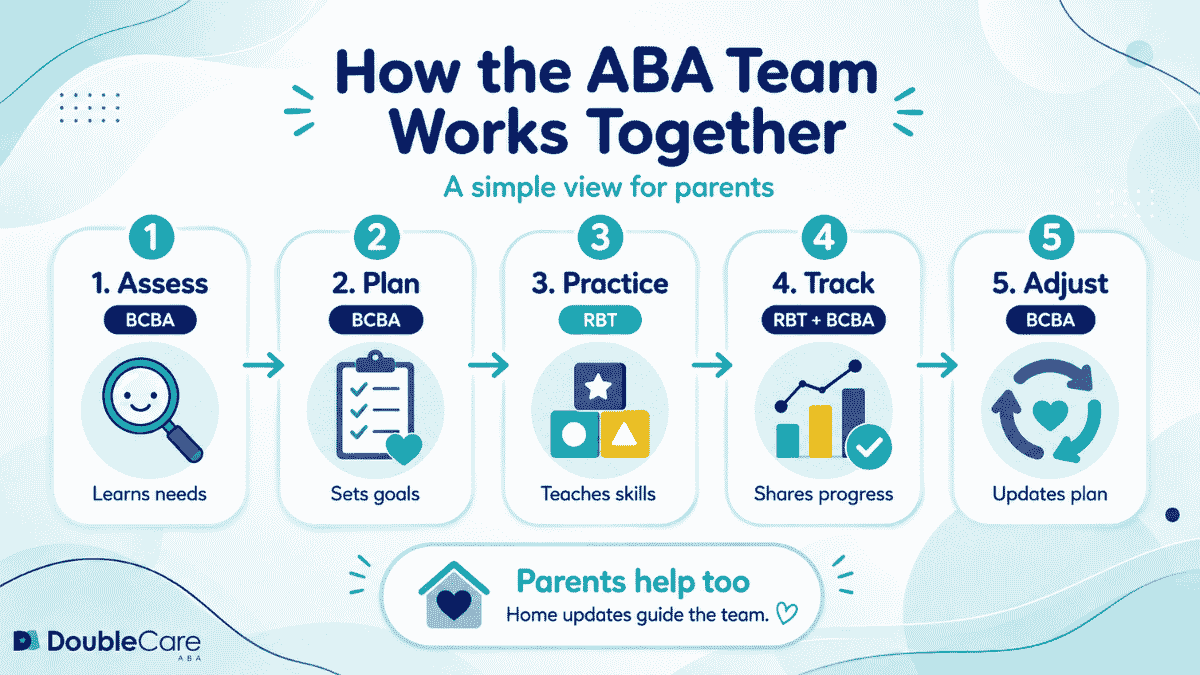
The working cycle flows in a continuous loop:
- The BCBA assesses the need and creates the goal.
- The RBT practices the skill during direct sessions.
- The RBT records data and reports notable events.
- The BCBA observes, reviews data, and coaches the RBT.
- The BCBA updates the plan when evidence supports a change.
- Parents share what they see between sessions.
The BCBA makes clinical changes after reviewing data and listening to your family. The RBT contributes valuable information but should not independently change procedures. Research supports this structured team approach.
A 2016 study published in Behavior Analysis in Practice examined 638 children receiving community-based ABA services. The data showed that children with BCBA supervisors mastered more learning objectives during treatment.
Connect with Our Clinical Supervisors
Parents shouldn’t have to wonder who is leading care or how session information reaches the supervising clinician. At Double Care ABA, our BCBAs assess each child, oversee the treatment plan, and supervise the direct-care team. Contact our team to ask how BCBA supervision and communication would work for your family.

Who Should Parents Contact About Different Questions?
Knowing who to call makes communication much easier to understand. You can use this quick guide to direct your questions to the right team member.
Questions for the RBT
- What activities did my child complete today?
- Which skills did you practice during the session?
- Did anything unusual affect your child's mood?
- What approved strategy did you model for me today?
- What information should I share with the BCBA?
Questions for the BCBA
- Why was this specific goal chosen?
- Is my child progressing at the expected rate?
- Can we discuss a new concern at home?
- Should the treatment plan change based on recent data?
- How is the RBT being trained and observed?
- What should our family practice between sessions?
- What happens when a goal has been mastered?
Administrative questions regarding scheduling, cancellations, insurance, and authorization should go directly to the provider’s administrative or intake team.
Families often experience confusion over private messaging with RBTs. We recommend asking your autism and ABA therapy provider at intake which communication channel includes the BCBA so your clinical concerns are documented correctly.
What Good BCBA Supervision Looks Like From a Parent’s View
Active BCBA supervision in ABA therapy should be visible through the quality of your child's daily care, even when you do not see every behind-the-scenes supervisory task.
Parents should be able to notice that:
- The BCBA knows your child’s current goals and recent session patterns.
- The BCBA periodically observes the RBT working with your child.
- The RBT receives specific feedback rather than general reminders.
- The treatment plan changes when goals are mastered or concerns develop.
- Different RBTs follow the same approved procedures.
- Parent observations reach the BCBA and receive a response.
- The BCBA can explain why a strategy is being used.
- New RBTs receive case-specific training before working independently.
If you have concerns, frame them as questions. How often will the BCBA observe sessions? How are RBTs trained on my child’s plan? How quickly are goals reviewed after mastery? Who should I contact when I see a new behavior at home? What happens when my child and an assigned RBT do not connect?

FAQs About BCBA vs RBT
Can my child work with more than one RBT?
A child may work with multiple registered behavior technicians due to scheduling or coverage needs. The supervising BCBA trains each RBT on the same plan and reviews session data so teaching remains consistent.
What should I do if my child doesn’t connect with the assigned RBT?
Share observations like fear or low engagement with the BCBA. The supervisor can observe a session, coach the RBT, adjust the pairing process, or discuss another assignment if the relationship affects treatment.
Can a BCBA provide direct ABA therapy sessions too?
Yes. A BCBA can provide direct services independently. However, many programs assign recurring direct care to an RBT while the BCBA handles assessments, planning, data review, caregiver training, and supervision.
Begin Your Child's Behavioral Support Services
A well-organized ABA team gives you an easy way to share concerns, understand progress, and know who holds responsibility for each clinical decision. The BCBA leads the clinical plan, while the RBT turns that plan into repeated practice during your child’s sessions.
At Double Care ABA, we provide BCBA-supervised ABA services for families across New York, New Jersey, Florida, Georgia, Virginia, Maryland, Pennsylvania, and North Carolina. Submit our online contact form or call our intake team to discuss your child’s needs. Our team will review service availability, discuss insurance information, and help schedule a free consultation with a clinical team member.